
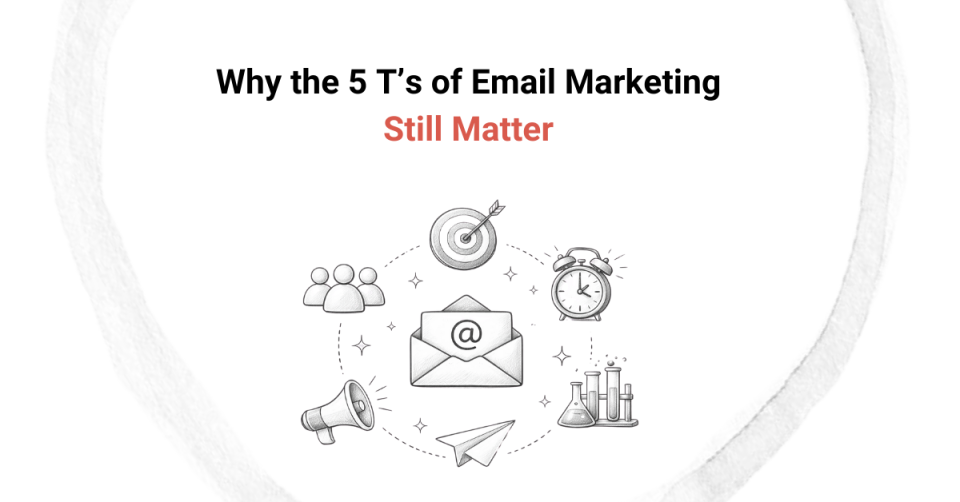
The five T’s of email marketing describe a simple but durable operating framework. Each “T” represents a decision point every campaign must pass through before sending. When one is weak, performance usually suffers somewhere else. When all five align, email becomes predictable, scalable, and resilient.
We often describe the five T’s as a pre-flight checklist. Before hitting send, you confirm who gets the message, when it lands, how it was validated, how it sounds, and how success will be measured. This structure keeps teams disciplined and removes guesswork. It also makes problems easier to diagnose when results slide.
Oftentimes these are simplified and implied when you’re talking to a strategist, or deliverability professional; right time, right message, right recipient. Lets dive into the five T’s and see how this idea can influence your email program.
Targeting
Targeting defines who should receive the message, and just as importantly, who should not. It relies on subscriber data such as engagement history, lifecycle stage, preferences, or behaviour. Even basic segmentation usually outperforms a full-list send. Relevance always wins, much like opt-in wins over opt-out lists when it comes to performance.
Good targeting reduces complaints, bounces, and fatigue. It also improves deliverability because mailbox providers reward engagement. A campaign sent to fewer, more interested people often drives more total conversions. Would you rather reach everyone, or the right people?
Timing
Timing focuses on when a message arrives in the inbox. This includes time of day, day of week, and seasonal context. Inbox competition fluctuates constantly. What worked last quarter may not work today.
Timing also covers frequency. Sending too often can lead to message fatigue, disengagement and spam complaints. Sending too little causes list decay and brand amnesia. The goal is sustainable visibility. Testing cadence by segment usually reveals clear tolerance thresholds. Offering frequency preferences can allow users to self manage how many emails they could receive in a set time period. Some Email Service Providers also have features that let the systems trigger emails at the most relevant time to a client, ask them about Send Time Optimization features.
Testing
Testing turns opinion into evidence. It answers questions like which subject line earns attention, or which layout drives clicks. Subject lines, preheaders, creative, offers, and calls to action all benefit from testing. Small gains compound quickly over time.
Effective testing isolates one variable at a time. Change everything at once, and results become meaningless. Clear hypotheses produce usable insights. Testing is not about perfection. It is about learning faster than your competitors.
Tone
Tone defines how your brand sounds and feels in the inbox. It signals trust, intent, and professionalism. A mismatch between message and moment creates friction. Subscribers notice immediately.
Tone should align with audience expectations and message purpose. Transactional emails should feel clear and reassuring. Promotional emails should feel confident, not desperate. Consistency matters more than cleverness. A human voice builds long-term engagement.
Tracking
Tracking measures whether the campaign achieved its goal. Opens, clicks, conversions, unsubscribes, bounces, and complaints each tell part of the story. No single metric provides the full picture. Context always matters.
Tracking also protects deliverability. Declining engagement is an early warning signal. Strong measurement supports smarter targeting and cleaner lists. If performance drops, tracking shows where to look first.
The Five T’s and Deliverability
The five T’s shape far more than campaign performance. Together, they determine how mailbox providers judge your sending behaviour. Targeting and timing influence engagement signals. Testing and tone affect trust and response quality. Tracking reveals problems early, before they turn into inbox placement issues.
Deliverability improves when all five T’s work together. Relevant targeting limits negative signals. Consistent timing builds predictable engagement. Testing strengthens opens, clicks, and your overall relationship with subscribers, while a clear tone helps reduce complaints. Tracking keeps the program healthy over time allowing you to adjust and improve your messaging. When email teams manage the five T’s as a system, better inbox placement becomes a byproduct of good marketing.
Which T deserves the most attention in your program right now? If you’re unsure, contact us to discuss a strategy that strengthens your use of the five T’s today. Book a call today.